 EN
EN  DE
DE 


Building sustainable neighbourhood energy: cold local heating network for Gronau (Leine)
The development of climate-neutral residential neighbourhoods requires engineering solutions that go beyond conventional supply concepts. While cities and local authorities are looking for cost-efficient, low-emission energy solutions, cold local heating networks are becoming increasingly important as a central component of sustainable urban planning.
In the new residential neighbourhood in Gronau (Leine) this vision becomes reality. Supported by the technical expertise of M&P Energy - Member of the SIERA Alliance, a network of European environmental and engineering experts, the project integrates a geothermal-based cold local heating network for the efficient and sustainable supply of a diverse building structure.
The neighbourhood comprises 82 detached houses, 86 semi-detached and terraced houses, 19 apartment blocks and a Day care centre. From the outset, the aim was to develop a robust, renewable energy concept that meets both the German climate targets and the strategic engineering principles of the SIERA Alliance.
Geothermal energy as the backbone of the energy concept
To supply the neighbourhood with heat, hot water and passive cooling, it is connected to a Cold local heating network This is a system that distributes low-temperature heat throughout the neighbourhood and enables building-specific heat pumps to generate heating energy with high efficiency.
The geothermal infrastructure was developed by M&P Energy - Member of the SIERA Alliance designed and technically validated based on comprehensive underground modelling, demand forecasts and simulation-based design scenarios.
Central system features
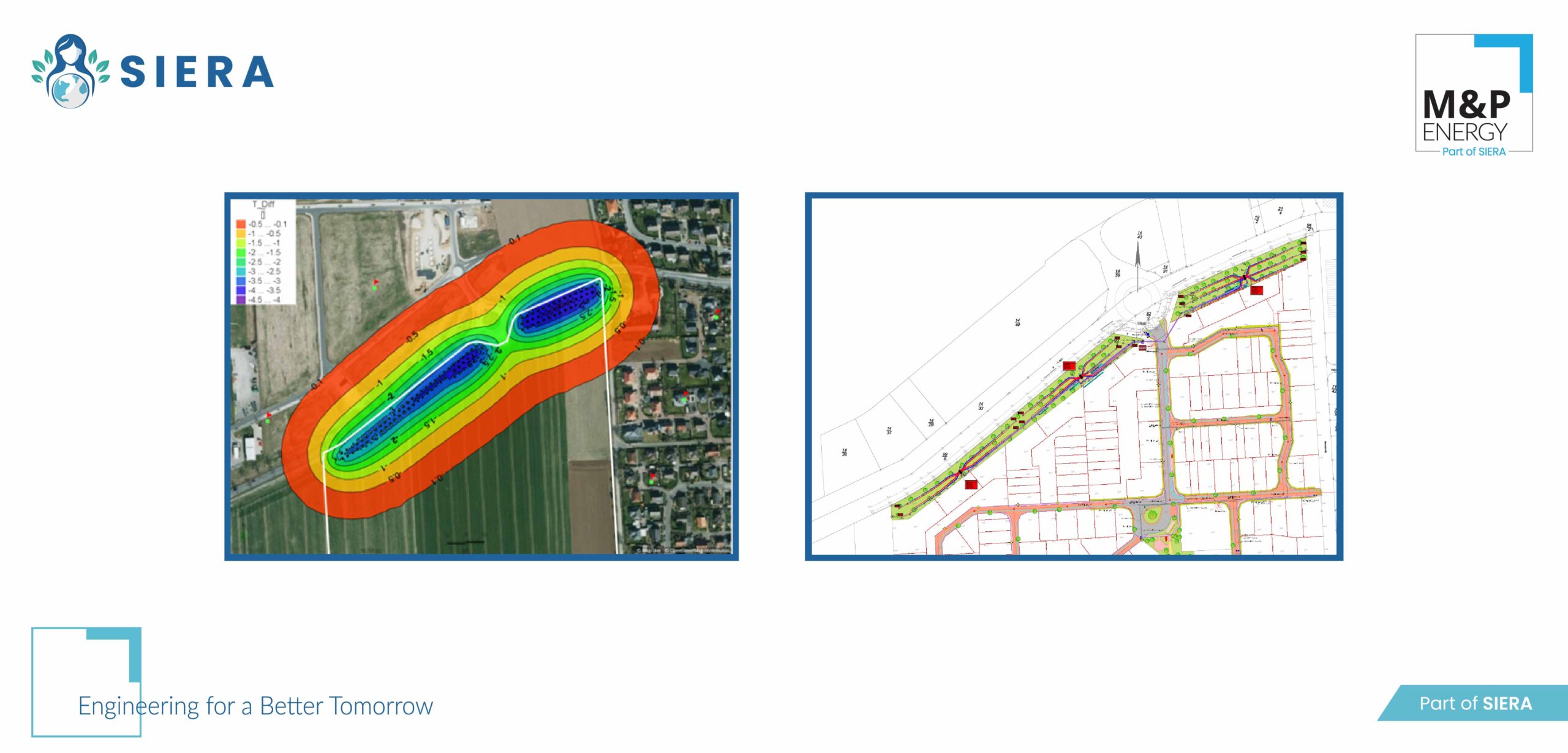
- 114 Geothermal probes, each at a distance of 8 metres
- Two probe fields in the northern green areas
- Increase in probe depth from 150 m to 180 m to ensure that the system can be operated efficiently and in compliance with authorisation requirements
- Three distribution shafts, connected to the technical centre
- Passive cooling via brine-to-water heat pumps and active regeneration via recooler
- Four monitoring measuring points (two groundwater measuring points + two temperature measuring points)
These components result in a closely interlinked system that is designed for stable thermal performance throughout the year.
Simulation-based planning by M&P Energy
A key development step was the detailed assessment of the geothermal underground parameters. M&P Energy used its expertise in hydrogeology, thermal simulation and sustainable energy system planning to carry out field investigations and thermodynamic modelling.
Initial simulations based on the existing 150 m pilot probe showed that the passive cooling requirements could not be achieved. For this reason, M&P Energy developed a revised simulation model that led to the installation of a new 180 m pilot probe and optimised planning parameters.
This analytical adjustment guaranteed:
- Stable performance in passive cooling mode
- Improved long-term thermal balance
- Increased efficiency
- Minimised operating risks
This evidence-based approach reflects the engineering philosophy of the SIERA Alliance precision, data-based decisions and life cycle-orientated thinking.
Thermal balance and seasonal regeneration
Efficient geothermal systems rely on both the extraction and regeneration of heat. M&P Energy has integrated a thermal management concept that balances the seasonal requirements:
Winter operation: Renewable heat
- Heat pumps extract energy from the ground.
- The soil temperatures drop in a controlled manner.
Summer mode: Passive cooling & active regeneration
- Buildings emit heat passively into the ground.
- Recoolers support active regeneration if required.
- Monitoring ensures compliance with all operating limits.
This bilateral seasonal cycle is crucial for operational stability and efficiency.
Environmental monitoring and authorisation security
Sustainable energy systems must be both technically robust and environmentally compatible. This is why M&P Energy has developed a comprehensive monitoring concept:
- Two groundwater measuring points + Two temperature measuring points for monitoring the temperature changes in the probe field and, if necessary, for adjusting the system operation, observation of the thermal propagation
- Heat quantity countersr for monitoring the actual heat extraction and input in the probe field
- Continuous evaluation to protect the environment and safeguard operating characteristics
These measures ensure transparency towards the authorities and strengthen the ecological orientation of the project within the SIERA Alliance.
An important milestone for the 2030 climate targets
Construction and commissioning of the probe fields and the cold local heating network begin from 2026 parallel to neighbourhood development.
The project shows how renewable neighbourhood energy can be systematically integrated into modern urban development. Through the combination of geothermal energy, simulation technology and interdisciplinary planning, the project demonstrates M&P Energy - Member of the SIERA Alliance, how modern infrastructure actively contributes to the 2030 climate targets.
Renewable heating and cooling is no longer a supplement - it is the central infrastructure of the future.
Call to Action
If you are planning a new residential neighbourhood, evaluating geothermal potential or looking for a robust, low-CO₂ energy concept, you can M&P Energy - Member of the SIERA Alliance support you from feasibility to implementation. Our experts develop data-based, sustainable energy systems that are designed for long-term performance.
Take Contact M&P Energy to develop a customised, future-proof energy solution for your neighbourhood. You can also contact the Contact SIERA Alliance, to find out how your network of experts can support your long-term energy and sustainability goals.
Together we stand for ‚, Engineering for a Better Tomorrow“.